
Why Account Profiling Matters for Brokers and Risk Teams
Account profiling is a decision tool, not a reporting exercise. Learn how separating behavioral stability, flow risk, and economic risk helps brokers prioritize the right accounts.
For brokers, account profiling is not a reporting exercise. It is a decision tool.
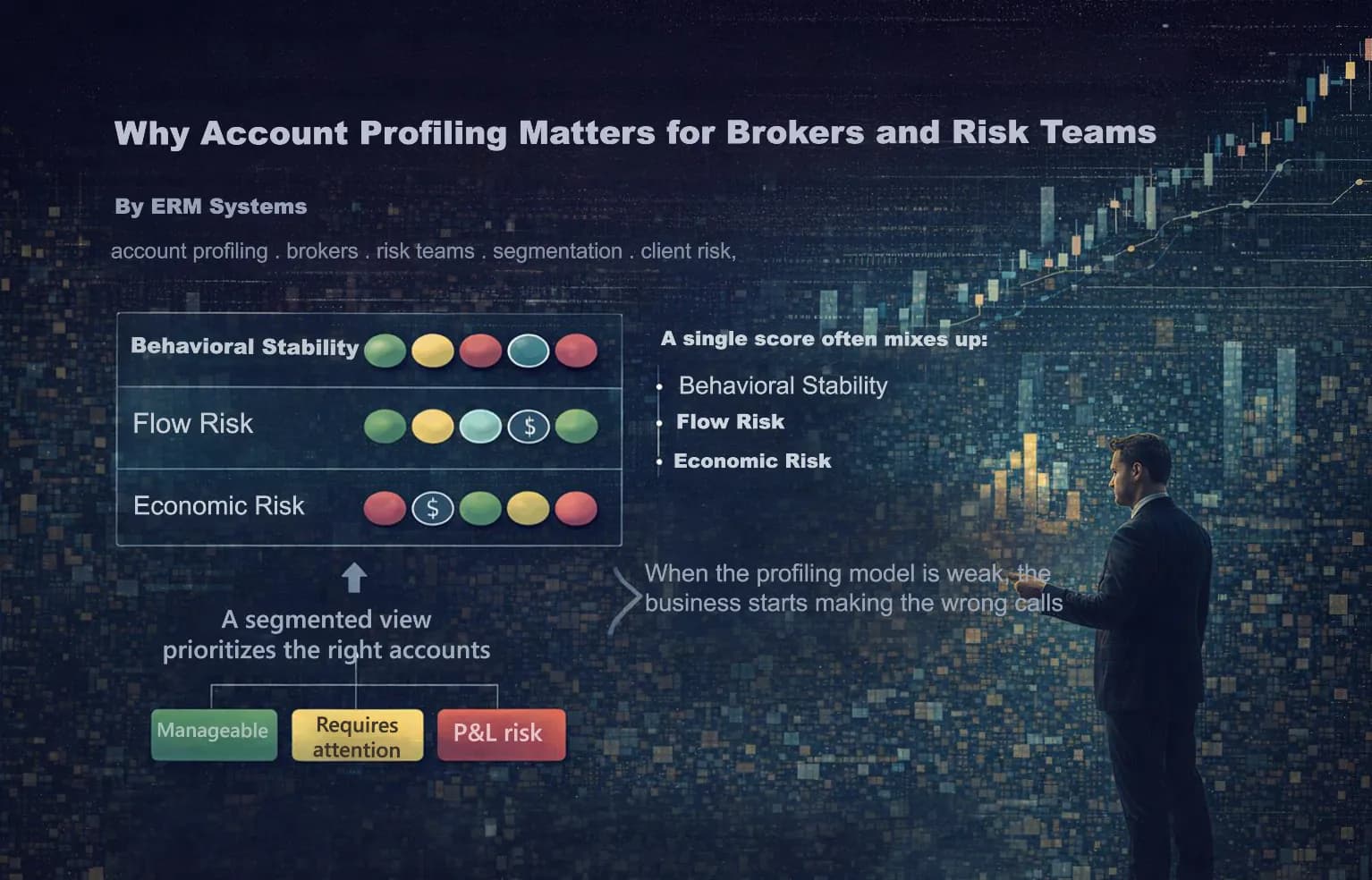
When the profiling model is weak, the business starts making the wrong calls:
- The wrong clients get escalated
- The wrong accounts receive dealing attention
- Segmentation becomes noisy
- Risk signals lose credibility
- Profitable and dangerous clients get mixed with harmless ones
This usually happens when too many different meanings are pushed into one score. A single number may look convenient, but it often hides three different questions:
- Is this client behaviorally stable?
- Is this flow operationally difficult?
- Is this client economically dangerous?
For a broker, these questions lead to different actions — which is why they should not be blended too early.
What Management Actually Needs
Heads of brokerage, risk, and dealing do not need more analytics. They need clearer prioritization.
They need to quickly understand:
- Which accounts are manageable
- Which accounts require dealing attention
- Which accounts create real P&L risk
- Which segments are moving in the wrong direction
This only works when profiling is built around business decisions, not a visually attractive scorecard.
A Practical Structure
At the management level, a simple three-part view is usually enough.
1. Behavioral Stability
Does the client trade in a consistent, understandable way? Or is the behavior erratic, reactive, and difficult to manage?
2. Operational / Flow Risk
Does this account create stress for execution, pricing, or infrastructure? Is the flow normal, or does it require special monitoring?
3. Economic Risk
What is the actual business impact of this account? Is it commercially valuable, neutral, or consistently costly for the broker?
This is enough to support segmentation, escalation, and resource allocation.
Why This Matters at Executive Level
Leadership decisions depend on clean definitions. If a broker cannot distinguish between unstable behavior, difficult flow, and economic danger, teams will keep reacting to symptoms instead of managing the real source of risk.
That creates predictable problems:
- Dealing focuses on the wrong accounts
- Risk escalates noise instead of exposure
- Product teams misread client segments
- Dashboards look convincing while decisions get weaker
The issue is not lack of data. It is lack of separation between meanings.
The Bottom Line
Good account profiling helps management answer a simple question: Where do we need attention, and why?
If the model cannot answer that clearly, it is not helping the business — it is only creating the appearance of control.